I never understood this accident from all the evidence that was available for six or seven years because it just didn't make sense. Why would two qualified pilots plan and execute this flight without taking sensible measures to reduce risk, why would they ignore the signs of a clearly unstable approach, and why would one pilot merely ask the other about going around, and why would the other pilot answer with a simple "no" to that? It just didn't make any sense. But seven years later, we now know why.
— James Albright
Updated:
2027-09-01
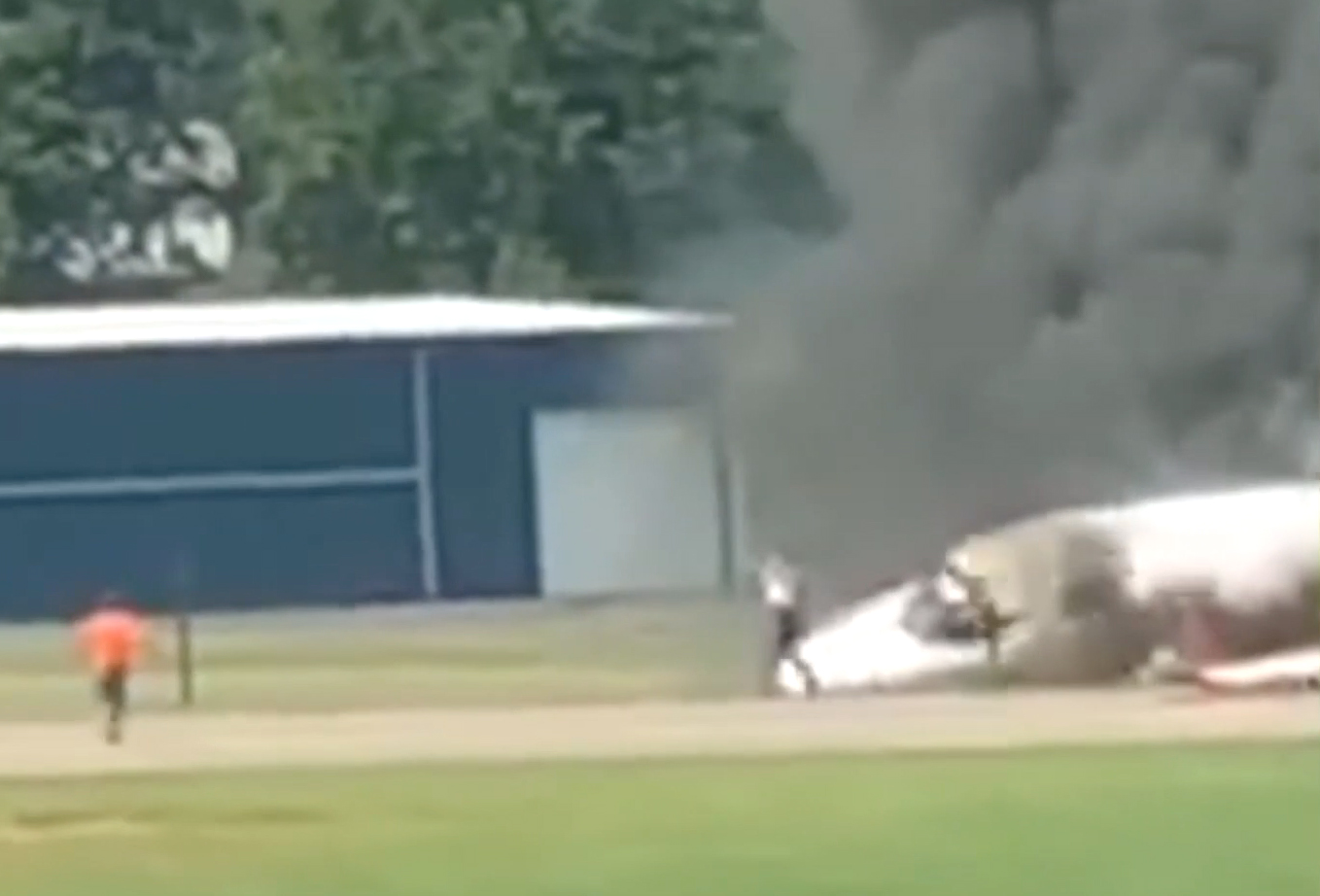
The Earnhardt family seen escaping from the aircraft
Click on the image for the video
As charitable people, we are often taken to excusing pilot actions as originating someplace other than the pilot. The pilot, you see, was under pressure from the boss. The pilot, it turns out, was put into a corner by Air Traffic Control. The Pilot Flying (PF), perhaps, was under the thumb of the Pilot Monitoring (PM) who happened to be the Pilot in Command (PIC), Chief Pilot (CP), or simply outranked him or her. It wasn’t the pilot’s fault, we say. No matter how many acronyms you choose to use, the pilot in question was not in control of the situation. Really?
I think in this case, the boss, racecar driver Dale Earnhardt, Jr., may have encouraged his top pilot to slowly but surely accept a normalization of deviance to the point where many Standard Operating Procedures were ignored. But it wasn't Mr. Earnhardt's fault. The top pilot caused the crash because he failed to tell the boss "no, I'm not doing that," along the way. Speculation? Read on . . .
1
Accident report
- Date: 15 August 2019
- Time: 1540
- Type: Cessna 680A Citation Latitude
- Operator: JRM Air LLC
- Registration: N8JR
- Fatalities: 0 of 2 crew, 0 of 3 passengers
- Aircraft Fate: Destroyed
- Phase: Landing
- Airport: (Departure) Statesville Municipal Airport, NC (KSVH), USA
- Airport: (Destination) Elizabethton Municipal Airport, TN (0A9), USA
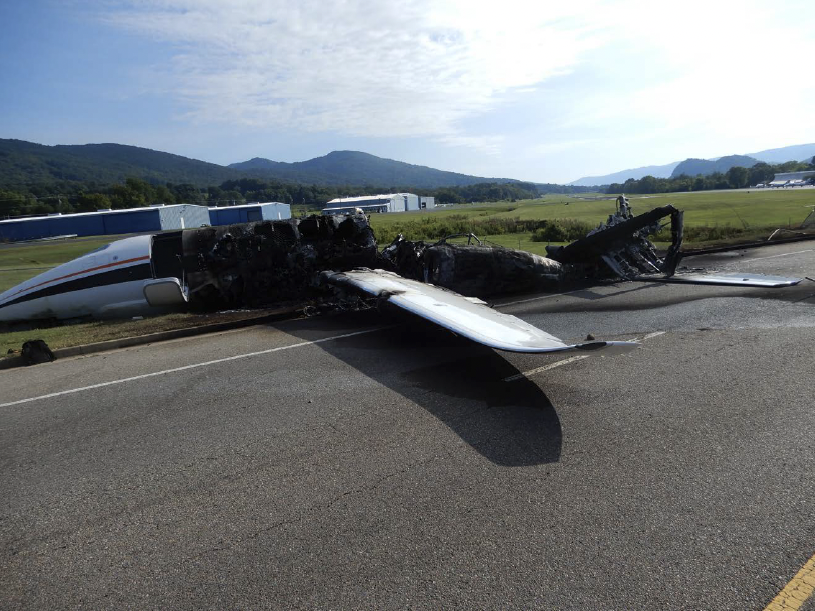
N8JR Main Wreckage (NTSB)
On August 15, 2019, two pilots managed to come very close to killing themselves, professional race car driver Dale Earnhardt, Jr., his wife, and his daughter. The series of mistakes along the way to destroying their aircraft were so obvious, I once called this the “I don’t under this accident” case study because the National Transportation Safety Board (NTSB) accident report covered the “what” but not the “why.” Thanks to Earnhardt himself, we now have the “why.” But let’s cover the “what” first.
The flight originated at the aircraft and aircrew’s homebase, Statesville Regional Airport (SVH), Stateville, NC. The destination was Elizabethton (OA9), Tennessee, an airport nestled in a valley.
The aircraft was a four-year-old Cessna Latitude, N8JR.
The PF was a 56-year-old pilot with 5,800 hours total flying time, 765 in type, with three type ratings, the accident aircraft being the largest. He had 2-1/2 years with the company. The PM was a 52-year-old pilot with 11,000 hours total flying time, 1,165 in type, with six type ratings, the accident aircraft being the largest. He was the flight department’s Director of Operations and had 14 years with the company. We often hypothesize about an authority gradient when the PM has double the PF’s experience and I think that would be correct looking at the Cockpit Voice Recorder (CVR) transcript. That authority gradient was verified in a post-crash interview with the owner, who referred to the PM as “my A pilot” and the PF as “the B pilot.” Note: I’ll refer to each pilot this way because I think it will help to understand the “why.”
They departed under Visual Flight Rules (VFR) without filing a fight plan or using air traffic services. They did announce their position on the Common Traffic Advisory Frequency (CTAF) for a visual approach to runway 24.
At 1533:00, the airplane began to turn left, and the crew conversation indicated that they had some difficulty visually acquiring the airport; the airplane then turned right and began to climb. At 1535:02, the descent resumed, and 10 seconds later the terrain avoidance and warning system (TAWS) excessive closure rate caution and warning alerts sounded in the cockpit as the airplane crossed a ridge at 710 ft above ground level (agl). The [A-pilot] asked the [B-pilot] if he saw the terrain, and the [B-pilot] responded, "yeah, I got it."
At 1535:27, the airplane began a shallow left turn to an extended final. As the approach to landing resumed, the descent rate increased; the autothrottle positioned the throttles to their minimum, 6º throttle lever angle, and the airspeed increased to 220 knots. At 1536:12, the [B-pilot] asked the [A-pilot] to position the flaps to the flaps 1 setting. The crew then manually positioned the throttles to 0º throttle lever angle, which disengaged the autothrottle; the throttles were not moved for the remainder of the approach. At 1536:29, the [B-pilot] stated, "slow down." At 1536:31, the [B-pilot] asked the [A-pilot] to lower the landing gear, and the [A-pilot] responded that he would after the airplane slowed down more. At 1536:36, the speedbrake lever was partially extended to a 33º lever angle, and the TAWS excessive descent rate caution alert sounded about 5 seconds later.
At 1536:47, about 3 nautical miles from touchdown and at 2,783 ft msl (781 ft agl), the speedbrake lever was extended to 41º for a total of 21 seconds then retracted after the airspeed decreased to 205 knots. At 1536:50, the landing gear were extended, and 7 seconds later, flaps 2 (15°) was selected; these actions were performed when the airplane reached the maximum speeds to perform those functions (205 knots and 195 knots, respectively).
As the flaps were extending, the TAWS forward looking terrain alert rate of terrain closure caution alert sounded twice (at 1536:59 and at 1537:09), then a warning alert sounded (at 1537:11). The airplane was at an altitude of 2,159 ft msl (471 ft agl). Following these alerts, the [B-pilot] selected full flaps and the descent rate and airspeed decreased.
At 1537:26, the [A-pilot] stated, "and I don't need to tell ya, we're really fast," and the [B-pilot] responded, "I'm at idle." Six seconds later, the [B-pilot] asked, "do I need to go around?" and the [A-pilot] responded, "no."
Source: ERA19FA248, Factual Information
Reading between the lines, the B-pilot asked permission to go around, the more senior A-pilot told him he could not.
At 1537:31, about 270 ft agl, the speedbrakes were partially extended for 5 seconds (to 140 ft agl). The [B-pilot] then stated, "I got the speed brakes out," to which the [A-pilot] responded, "well you should get rid of those because we don't wanna get a CAS [Crew Alerting System] m- or a thing sent to ya." Eight seconds before touchdown, at 1537:41, the [B-pilot] stated, "alright, I'll be on the T-Rs [thrust reversers] quickly." For the computed airplane weight, the reference speed (Vref) for the final approach was 108 knots; the airplane's airspeed at the runway's displaced threshold was 126 knots. Five seconds before touchdown, the airplane's descent rate was over 1,500 ft per minute (fpm).
According to airport surveillance video and recorded data, the airplane first briefly touched down with a bounce on the runway designator about 240 ft past the displaced threshold with about 3,860 ft of paved surface remaining. The airplane then touched down two more times, bouncing each time, then continued airborne over the runway until it touched down a fourth time with about 1,120 ft of paved surface remaining.
When the airplane touched down initially at 1537:49, it was traveling 126 knots (18 knots above Vref) and had a descent rate of 600 fpm (the maximum allowed per the airplane flight manual [AFM]). All three landing gear registered "on-ground" simultaneously with a vertical acceleration of 1.4 gravitational acceleration (g), and thrust reverser deployment was commanded 0.4 second after the landing gear first touched the ground as the throttles were moved to the reverse idle position; however, the airplane bounced after touching down for 0.6 second and was airborne again before the thrust reverser command could be executed.
When the airplane touched down a second time, 1.2 seconds later at 1.6 g, the nose landing gear touched down first, followed immediately by the right main landing gear. The left main landing gear never registered on-ground during the touchdown, and the airplane bounced and became airborne again after 0.4 second.
The airplane touched down a third time, 1.8 seconds later at 1.7 g and about 1,000 ft down the runway with about 3,100 ft of paved surface remaining. The thrust reversers unlocked 0.4 second after all three landing gear registered on-ground because the reverser deployment command from the first touchdown was still active. Almost immediately after the thrust reversers unlocked, the pilot advanced the throttles to idle, sending a thrust reverser stow command at 1537:54; however, the landing gear status changed to "in-air" almost simultaneously when the command was executed.
The airplane bounced after 0.6 second and became airborne a third time, and the in-air landing gear status triggered a cut in hydraulic power to the thrust reverser actuators, which is intended to prevent the airborne deployment of a thrust reverser. The cut in hydraulic power to the thrust reversers allowed the unlocked thrust reversers to be pulled open by aerodynamic forces. The amber "T/R UNLOCK CAS" message illuminated and the thrust reverser emergency stow switches began to flash. The pilot advanced the throttles to maximum takeoff power 0.7 second later in an attempt to go around; however, the thrust reversers reached full deployment 0.4 second after that. The airplane's full authority digital engine controls (FADEC), by design, prevented an increase in engine power while the thrust reversers were deployed. The red "T/R DEPLOY CAS" message was displayed in the cockpit, indicating that the thrust reversers were deployed, and the thrust reverser emergency stow switches continued to flash.
The pilots later reported that they attempted to conduct a go-around; however, the engines did not respond as expected, so they landed straight ahead on the runway. While the airplane was airborne, the crew partially retracted the flaps as the airspeed decreased from 119 knots to 91 knots. The pilot retarded the throttles partially but not to idle, then pushed the throttles forward again with no effect because the FADEC continued to prevent an increase in thrust; the pilot then pulled back the throttles to idle. While airborne for 9.6 seconds, the airplane reached an altitude of about 24 ft agl.
The stick shaker activated 0.5 second before the airplane touched down for the fourth and final time at 1538:03, warning of an imminent stall. The airplane touched down hard with a peak acceleration of 3.2 g on the left and right main landing gear, then the left main landing gear came off the ground then contacted the ground again. The nose gear contacted the ground about 0.5 second later. The left inboard wheel brake pressure increased to near maximum after the left main gear touched down; however, the left outboard and right wheel brake pressure did not increase significantly, indicating that only the left inboard tire was firmly contacting the runway. When all three landing gear touched down on the runway at 1538:06, the thrust reverser system was reenergized and the thrust reversers stowed 0.9 second later because the throttles were at idle.
Airport surveillance video showed that the right main landing gear collapsed at 1538:04 and that the outboard section of the right wing contacted the runway immediately thereafter. The airplane then departed the 97-ft-long paved surface beyond the end of the runway and traveled through a 400-ft-long open area of grass, down an embankment, through a creek, through a chain-link fence, and up an embankment. Photographs of the accident scene showed that the airplane came to rest on the edge of a four-lane highway about 600 ft beyond the runway threshold. In postaccident interviews with the flight crew, they reported that they secured the engines after the airplane came to a stop and assisted the passengers with the evacuation through the main entry door as a postaccident fire erupted, which eventually destroyed the airplane.
Source: ERA19FA248, Factual Information
Mr. Earnhardt and the B-pilot attempted to open the overwing exit but it wouldn’t budge. The main cabin door was partially blocked, but all five occupants were able to exit.
When the copilot was asked in postaccident interviews if he thought the approach was stabilized, he responded "no."
Source: ERA19FA248, p. 10
Of course the approach was wildly unstable but the [B-pilot] didn’t feel compelled to go around and simply “asked permission.” The [A-pilot] didn’t hesitate to veto the idea with a simple “no.” The NTSB tells us what happened but not why:
The National Transportation Safety Board determines the probable cause(s) of this accident to be: The pilot's continuation of an unstabilized approach despite recognizing associated cues and the flight crew's decision not to initiate a go-around before touchdown, which resulted in a bounced landing, a loss of airplane control, a landing gear collapse, and a runway excursion. Contributing to the accident was the pilot's failure to deploy the speedbrakes during the initial touchdown, which may have prevented the runway excursion, and the pilot's attempt to go around after deployment of the thrust reversers.
Source: ERA19FA248, pp. 2-3
2
The owner's weighs in
Seven years later, Dale Earnhardt, Jr, provided additional clues in an extraordinary interview:
I’ll quote him a few times, but preface this with that he attempts to accept full responsibility and in effect exonerate both pilots. This provides a clue to the “why” but not the “why” itself.
“I had two great pilots, good dudes. I trusted them. I still do. But over the course of operating an airplane for years, I had sorta indirectly encouraged us to cut some corners on cost.”
“There were all these things that we got into the habit of doing that were . . . we didn’t need to be doing.”
“If its three hundred foot ceilings . . . ah, we’ll be okay. Then you’re flying at night, you’re landing on a short runway . . . you gotta be perfect. . . you’re messing with your odds.”
“They’ll swap seats. So my A pilot will fly, the B pilot will fly, in the left seat as the captain, and that’s common if your guys are rated properly for that . . . I didn’t have my A guy in the captain’s chair but that weren’t never . . . shouldn’t have been an issue . . . but I would say he didn’t do anything wrong . . . I put him in a bad spot as an owner of that airplane . . . I take full responsibility. I put him in a spot where he was heavy, he had a short runway, and he had some tough terrain to get down and get down quick in the hills of Bristol, Tennessee. And those are all decisions that come from the top.”
Source: “Dale Earnhardt Jr. Opens Up About His Most Dangerous Plane Crash
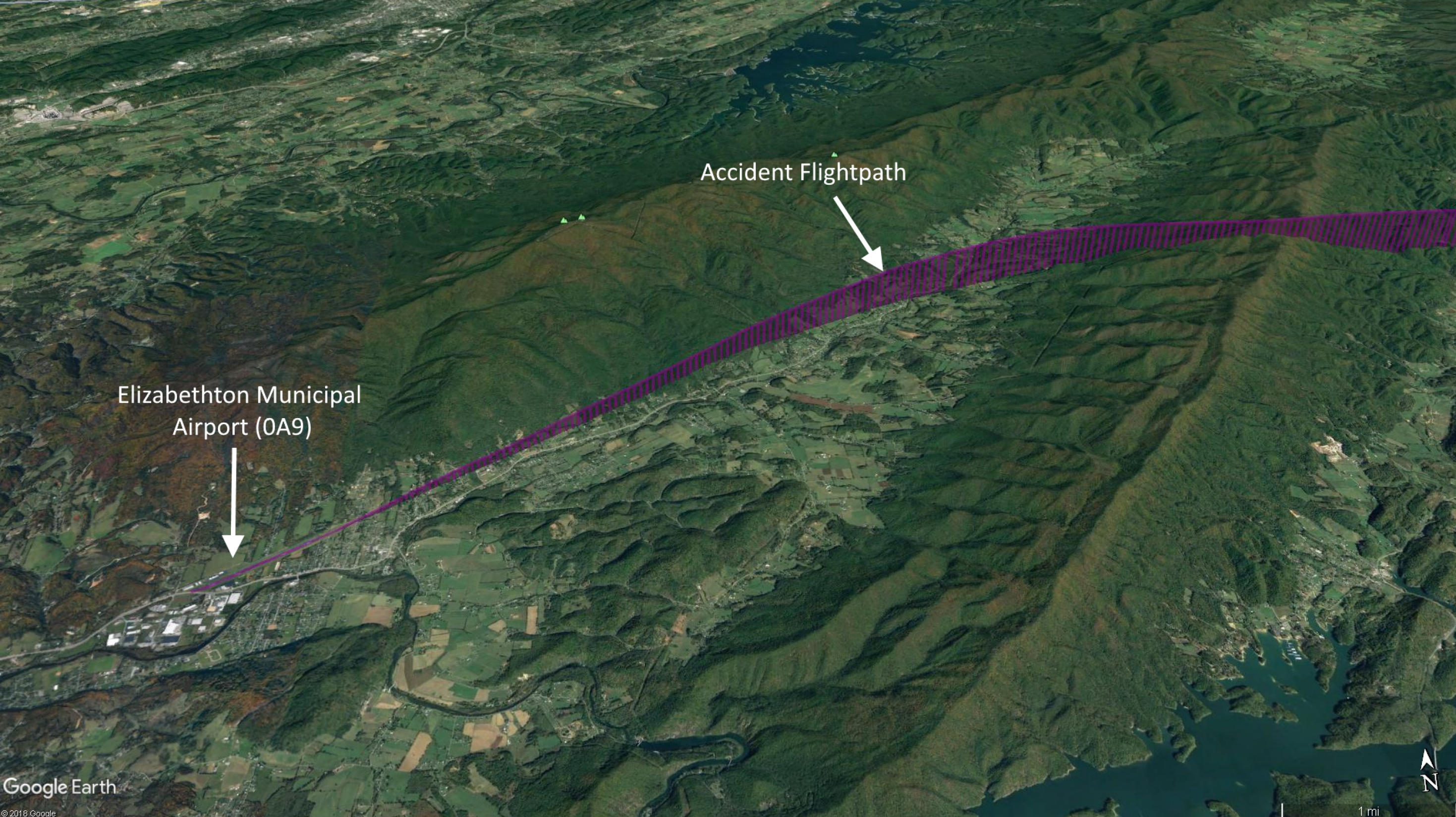
Accident flight path, ERA19FA248
“Two great pilots” would not have conducted this flight in the manner planned by Pilot-A and executed by Pilot-B. Among the mistakes:
- They should have filed an IFR flight plan to help deconflict their route with other aircraft and to stack the odds in their favor looking for the airport.
- It appears they chose Runway 06 to reduce flight time, but it was the more challenging runway because of terrain. An RNAV(GPS) was available to ensure terrain clearance and to help locate the runway. They ended up too fast partly because they were unsure of distance remaining. The instrument approach would have greatly increased their situational awareness.
- If a visual approach was a priority, the opposite runway was generally clear of terrain.
- Pilot-A clearly realized they were unstable: “we’re really fast.” Pilot-B said as much in his post-crash interview and “asked” if a go around was necessary. But the fact the approach was unstable did not result in a go around.
Why did this crash happen? In my opinion, the owner directed, implied, or made the pilots feel that getting from Point A to Point B was the most important objective and the need for standard operating procedures or outside oversight was either discouraged or ignored. As the flight department continued under the A-pilot’s leadership, the A-pilot was either prone to or grew to accept a normalization of deviance. The cause of this crash was not the decisions that “came from the top,” but the decisions made by the pilots. The A-pilot’s procedural intentional noncompliance which may have been a part of his philosophy when hired or may have been normalized with his inability to tell the owner “I’m not doing that.” Either way, Pilot-A’s attitude led to this nearly fatal crash.
3
"There I was . . ."
If you’ve been a successful commercial pilot for more than a few years, you are bound to have a few stories about when decisions made at the top ran contrary to safety. For example:
Things were going smoothly for the first several months after I took over a flight department when the mechanic passed along a message from the CEO that she was in a hurry and to have the engines running when she arrived. I told the mechanic, “I’m not doing that.” He said, “nice knowing you, the last two chief pilots were fired for less.” She arrived and asked why the engines weren’t running. “I’m not doing that.” “Why not?” “It’s too risky and not safe.” She never asked again.
The management company mandated the order of airports for a month long trip through Africa, including having to depart a small airport in the southern part of the continent for France, a long-distance flight for our Gulfstream GV. I let them know the order of airports had to be changed because the aircraft’s weight, when loaded for the long flight, exceeded the airport’s pavement classification number. They ordered me to do it anyway. I said no. They called the aircraft owner who called me, saying a half-million-dollar charter was at risk and that I should play ball. “I’m not doing that.” He backed down, the management company backed down, and the charter customer said it wasn’t a big deal to change the order.
These things happen in the military too. I had just started engines in our C-20A (Gulfstream III) for a trip into Sarajevo back when there was a shooting war going on. We were the only noncombat rated aircraft authorized in. After we began our taxi, the base’s command post ordered us to return to parking to pick up several aircraft lead acid batteries for a stranded C-130. “I’m not doing that.” “This order is coming from Alpha (the wing commander).” We took off. I heard after the fact that Alpha went ballistic until someone pointed out that the HAZMAT rules for our C-20 were substantially more strict than for the C-130.
Over the years I’ve had more than a few of these orders from “the top” and a few times someone mentioned my job was at risk. I said I’d rather be fired than dead, or have my license pulled. I know this seems overly dramatic, but in this particular case study, it seems the aircraft owner was quite reasonable. I think had Pilot A at some point said he was uncomfortable cutting corners, I think that would have carried the day.
References
(Source material)
NTSB Aviation Accident Final Report, Textron Aviation Inc 680A, August 15, 2019, ERA 19FA248