As charitable people, we are often taken to excusing pilot actions as originating someplace other than the pilot. The pilot, you see, was under pressure from the boss. The pilot, it turns out, was put into a corner by Air Traffic Control. The Pilot Flying (PF), perhaps, was under the thumb of the Pilot Monitoring (PM) who happened to be the Pilot in Command (PIC), Chief Pilot (CP), or simply outranked him or her. It wasn’t the pilot’s fault, we say. No matter how many acronyms you choose to use, the pilot in question was not in control of the situation. Really?
— James Albright
Updated:
2026-09-01
I’ve covered these three case studies before, but it wasn’t until the crash of Cessna 680A N8JR that I made the connection: when we condition ourselves to accept these excuses, we make it more likely we will accept those excuses for ourselves. “I’ll do ____, which I know is wrong, because ____ told me to.” The sad thing is we almost always get away with it, making it easier to stretch our limits even further. Three case studies, in particular, come to mind:
1 — Cessna 680A, N8JR, August 15, 2019, Elizabethton Municipal Airport, TN
2 — Southwest Airlines 1455, March 5, 2000, Burbank Airport, Burbank, CA
3 — Learjet 45XR, N279AJ, January 3, 2009, Telluride Regional Airport, CO
I think in each case, the results would have been different had the pilot flying the jet simply said:
1
Tell the owner or the CEO, "I'm not doing that."
Cessna 680A, N8JR, August 15, 2019, Elizabethton Municipal Airport, TN
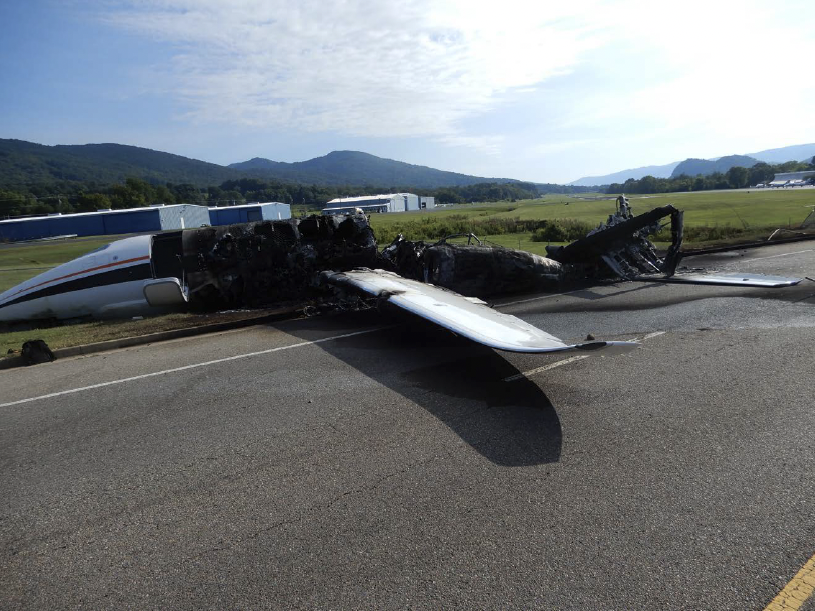
N8JR Main Wreckage (NTSB photo)
On August 15, 2019, two pilots managed to come very close to killing themselves, professional race car driver Dale Earnhardt, Jr., his wife, and his daughter. The series of mistakes along the way to destroying their aircraft were so obvious, I once called this the “I don’t under this accident” case study because the National Transportation Safety Board (NTSB) accident report covered the “what” but not the “why.” Thanks to Earnhardt himself, we now have the “why.” But let’s cover the “what” first.
The flight originated at the aircraft and aircrew’s homebase, Statesville Regional Airport (SVH), Stateville, NC. The destination was Elizabethton (OA9), Tennessee, an airport nestled in a valley.
The aircraft was a four-year-old Cessna Latitude, N8JR.
The crew.
The PF was a 56-year-old pilot with 5,800 hours total flying time, 765 in type, with three type ratings, the accident aircraft being the largest. He had 2-1/2 years with the company. The PM was a 52-year-old pilot with 11,000 hours total flying time, 1,165 in type, with six type ratings, the accident aircraft being the largest. He was the flight department’s Director of Operations and had 14 years with the company. We often hypothesize about an authority gradient when the PM has double the PF’s experience and I think that would be correct looking at the Cockpit Voice Recorder (CVR) transcript. That authority gradient was verified in a post-crash interview with the owner, who referred to the PM as “my A pilot” and the PF as “the B pilot.” Note: I’ll refer to each pilot this way because I think it will help to understand the “why.”
The accident flight.
They departed under Visual Flight Rules (VFR) without filing a fight plan or using air traffic services. They did announce their position on the Common Traffic Advisory Frequency (CTAF) for a visual approach to runway 24.
At 1533:00, the airplane began to turn left, and the crew conversation indicated that they had some difficulty visually acquiring the airport; the airplane then turned right and began to climb. At 1535:02, the descent resumed, and 10 seconds later the terrain avoidance and warning system (TAWS) excessive closure rate caution and warning alerts sounded in the cockpit as the airplane crossed a ridge at 710 ft above ground level (agl). The [A-pilot] asked the [B-pilot] if he saw the terrain, and the [B-pilot] responded, "yeah, I got it."
At 1535:27, the airplane began a shallow left turn to an extended final. As the approach to landing resumed, the descent rate increased; the autothrottle positioned the throttles to their minimum, 6º throttle lever angle, and the airspeed increased to 220 knots. At 1536:12, the [B-pilot] asked the [A-pilot] to position the flaps to the flaps 1 setting. The crew then manually positioned the throttles to 0º throttle lever angle, which disengaged the autothrottle; the throttles were not moved for the remainder of the approach. At 1536:29, the [B-pilot] stated, "slow down." At 1536:31, the [B-pilot] asked the [A-pilot] to lower the landing gear, and the [A-pilot] responded that he would after the airplane slowed down more. At 1536:36, the speedbrake lever was partially extended to a 33º lever angle, and the TAWS excessive descent rate caution alert sounded about 5 seconds later.
At 1536:47, about 3 nautical miles from touchdown and at 2,783 ft msl (781 ft agl), the speedbrake lever was extended to 41º for a total of 21 seconds then retracted after the airspeed decreased to 205 knots. At 1536:50, the landing gear were extended, and 7 seconds later, flaps 2 (15°) was selected; these actions were performed when the airplane reached the maximum speeds to perform those functions (205 knots and 195 knots, respectively).
As the flaps were extending, the TAWS forward looking terrain alert rate of terrain closure caution alert sounded twice (at 1536:59 and at 1537:09), then a warning alert sounded (at 1537:11). The airplane was at an altitude of 2,159 ft msl (471 ft agl). Following these alerts, the [B-pilot] selected full flaps and the descent rate and airspeed decreased.
At 1537:26, the [A-pilot] stated, "and I don't need to tell ya, we're really fast," and the [B-pilot] responded, "I'm at idle." Six seconds later, the [B-pilot] asked, "do I need to go around?" and the [A-pilot] responded, "no."
Source: ERA19FA248, Factual Information
Reading between the lines, the B-pilot asked permission to go around, the more senior A-pilot told him he could not.
At 1537:31, about 270 ft agl, the speedbrakes were partially extended for 5 seconds (to 140 ft agl). The [B-pilot] then stated, "I got the speed brakes out," to which the [A-pilot] responded, "well you should get rid of those because we don't wanna get a CAS [Crew Alerting System] m- or a thing sent to ya." Eight seconds before touchdown, at 1537:41, the [B-pilot] stated, "alright, I'll be on the T-Rs [thrust reversers] quickly." For the computed airplane weight, the reference speed (Vref) for the final approach was 108 knots; the airplane's airspeed at the runway's displaced threshold was 126 knots. Five seconds before touchdown, the airplane's descent rate was over 1,500 ft per minute (fpm).
According to airport surveillance video and recorded data, the airplane first briefly touched down with a bounce on the runway designator about 240 ft past the displaced threshold with about 3,860 ft of paved surface remaining. The airplane then touched down two more times, bouncing each time, then continued airborne over the runway until it touched down a fourth time with about 1,120 ft of paved surface remaining.
When the airplane touched down initially at 1537:49, it was traveling 126 knots (18 knots above Vref) and had a descent rate of 600 fpm (the maximum allowed per the airplane flight manual [AFM]). All three landing gear registered "on-ground" simultaneously with a vertical acceleration of 1.4 gravitational acceleration (g), and thrust reverser deployment was commanded 0.4 second after the landing gear first touched the ground as the throttles were moved to the reverse idle position; however, the airplane bounced after touching down for 0.6 second and was airborne again before the thrust reverser command could be executed.
When the airplane touched down a second time, 1.2 seconds later at 1.6 g, the nose landing gear touched down first, followed immediately by the right main landing gear. The left main landing gear never registered on-ground during the touchdown, and the airplane bounced and became airborne again after 0.4 second.
The airplane touched down a third time, 1.8 seconds later at 1.7 g and about 1,000 ft down the runway with about 3,100 ft of paved surface remaining. The thrust reversers unlocked 0.4 second after all three landing gear registered on-ground because the reverser deployment command from the first touchdown was still active. Almost immediately after the thrust reversers unlocked, the pilot advanced the throttles to idle, sending a thrust reverser stow command at 1537:54; however, the landing gear status changed to "in-air" almost simultaneously when the command was executed.
The airplane bounced after 0.6 second and became airborne a third time, and the in-air landing gear status triggered a cut in hydraulic power to the thrust reverser actuators, which is intended to prevent the airborne deployment of a thrust reverser. The cut in hydraulic power to the thrust reversers allowed the unlocked thrust reversers to be pulled open by aerodynamic forces. The amber "T/R UNLOCK CAS" message illuminated and the thrust reverser emergency stow switches began to flash. The pilot advanced the throttles to maximum takeoff power 0.7 second later in an attempt to go around; however, the thrust reversers reached full deployment 0.4 second after that. The airplane's full authority digital engine controls (FADEC), by design, prevented an increase in engine power while the thrust reversers were deployed. The red "T/R DEPLOY CAS" message was displayed in the cockpit, indicating that the thrust reversers were deployed, and the thrust reverser emergency stow switches continued to flash.
The pilots later reported that they attempted to conduct a go-around; however, the engines did not respond as expected, so they landed straight ahead on the runway. While the airplane was airborne, the crew partially retracted the flaps as the airspeed decreased from 119 knots to 91 knots. The pilot retarded the throttles partially but not to idle, then pushed the throttles forward again with no effect because the FADEC continued to prevent an increase in thrust; the pilot then pulled back the throttles to idle. While airborne for 9.6 seconds, the airplane reached an altitude of about 24 ft agl.
The stick shaker activated 0.5 second before the airplane touched down for the fourth and final time at 1538:03, warning of an imminent stall. The airplane touched down hard with a peak acceleration of 3.2 g on the left and right main landing gear, then the left main landing gear came off the ground then contacted the ground again. The nose gear contacted the ground about 0.5 second later. The left inboard wheel brake pressure increased to near maximum after the left main gear touched down; however, the left outboard and right wheel brake pressure did not increase significantly, indicating that only the left inboard tire was firmly contacting the runway. When all three landing gear touched down on the runway at 1538:06, the thrust reverser system was reenergized and the thrust reversers stowed 0.9 second later because the throttles were at idle.
Airport surveillance video showed that the right main landing gear collapsed at 1538:04 and that the outboard section of the right wing contacted the runway immediately thereafter. The airplane then departed the 97-ft-long paved surface beyond the end of the runway and traveled through a 400-ft-long open area of grass, down an embankment, through a creek, through a chain-link fence, and up an embankment. Photographs of the accident scene showed that the airplane came to rest on the edge of a four-lane highway about 600 ft beyond the runway threshold. In postaccident interviews with the flight crew, they reported that they secured the engines after the airplane came to a stop and assisted the passengers with the evacuation through the main entry door as a postaccident fire erupted, which eventually destroyed the airplane.
Source: ERA19FA248, Factual Information
Mr. Earnhardt and the B-pilot attempted to open the overwing exit but it wouldn’t budge. The main cabin door was partially blocked, but all five occupants were able to exit.
When the copilot was asked in postaccident interviews if he thought the approach was stabilized, he responded "no."
Source: ERA19FA248, p. 10
Of course the approach was wildly unstable but the [B-pilot] didn’t feel compelled to go around and simply “asked permission.” The [A-pilot] didn’t hesitate to veto the idea with a simple “no.” The NTSB tells us what happened but not why:
The National Transportation Safety Board determines the probable cause(s) of this accident to be: The pilot's continuation of an unstabilized approach despite recognizing associated cues and the flight crew's decision not to initiate a go-around before touchdown, which resulted in a bounced landing, a loss of airplane control, a landing gear collapse, and a runway excursion. Contributing to the accident was the pilot's failure to deploy the speedbrakes during the initial touchdown, which may have prevented the runway excursion, and the pilot's attempt to go around after deployment of the thrust reversers.
Source: ERA19FA248, pp. 2-3
Seven years later . . .
Seven years later, Dale Earnhardt, Jr, provided additional clues in an extraordinary interview: YouTube. I’ll quote him a few times, but preface this with that he attempts to accept full responsibility and in effect exonerate both pilots. This provides a clue to the “why” but not the “why” itself.
“I had two great pilots, good dudes. I trusted them. I still do. But over the course of operating an airplane for years, I had sorta indirectly encouraged us to cut some corners on cost.”
“There were all these things that we got into the habit of doing that were . . . we didn’t need to be doing.”
“If its three hundred foot ceilings . . . ah, we’ll be okay. Then you’re flying at night, you’re landing on a short runway . . . you gotta be perfect. . . you’re messing with your odds.”
“They’ll swap seats. So my A pilot will fly, the B pilot will fly, in the left seat as the captain, and that’s common if your guys are rated properly for that . . . I didn’t have my A guy in the captain’s chair but that weren’t never . . . shouldn’t have been an issue . . . but I would say he didn’t do anything wrong . . . I put him in a bad spot as an owner of that airplane . . . I take full responsibility. I put him in a spot where he was heavy, he had a short runway, and he had some tough terrain to get down and get down quick in the hills of Bristol, Tennessee. And those are all decisions that come from the top.”
Source: “Dale Earnhardt Jr. Opens Up About His Most Dangerous Plane Crash
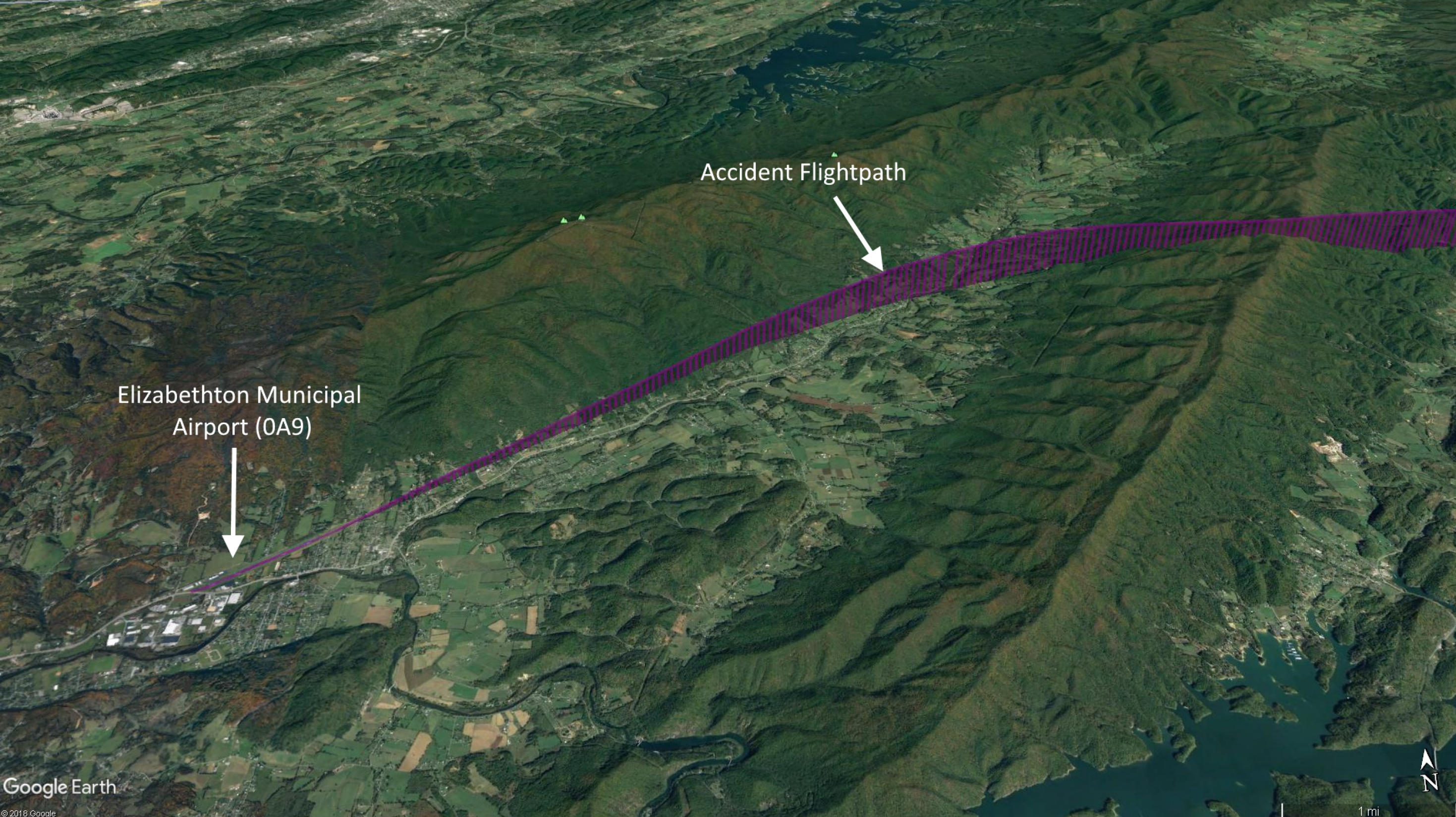
N8JR Flight Path (NTSB)
“Two great pilots” would not have conducted this flight in the manner planned by Pilot-A and executed by Pilot-B. Among the mistakes:
- They should have filed an IFR flight plan to help deconflict their route with other aircraft and to stack the odds in their favor looking for the airport.
- It appears they chose Runway 06 to reduce flight time, but it was the more challenging runway because of terrain. An RNAV(GPS) was available to ensure terrain clearance and to help locate the runway. They ended up too fast partly because they were unsure of distance remaining. The instrument approach would have greatly increased their situational awareness.
- If a visual approach was a priority, the opposite runway was generally clear of terrain.
- Pilot-A clearly realized they were unstable: “we’re really fast.” Pilot-B said as much in his post-crash interview and “asked” if a go around was necessary. But the fact the approach was unstable did not result in a go around.
Why did this crash happen? In my opinion, the owner directed, implied, or made the pilots feel that getting from Point A to Point B was the most important objective and the need for standard operating procedures or outside oversight was either discouraged or ignored. As the flight department continued under the A-pilot’s leadership, the A-pilot was either prone to or grew to accept a normalization of deviance. The cause of this crash was not the decisions that “came from the top,” but the decisions made by the pilots. The A-pilot’s procedural intentional noncompliance which may have been a part of his philosophy when hired or may have been normalized with his inability to tell the owner “I’m not doing that.” Either way, Pilot-A’s attitude led to this nearly fatal crash.
"There I was . . .""
If you’ve been a successful commercial pilot for more than a few years, you are bound to have a few stories about when decisions made at the top ran contrary to safety. For example:
Things were going smoothly for the first several months after I took over a flight department when the mechanic passed along a message from the CEO that she was in a hurry and to have the engines running when she arrived. I told the mechanic, “I’m not doing that.” He said, “nice knowing you, the last two chief pilots were fired for less.” She arrived and asked why the engines weren’t running. “I’m not doing that.” “Why not?” “It’s too risky and not safe.” She never asked again.
The management company mandated the order of airports for a month long trip through Africa, including having to depart a small airport in the southern part of the continent for France, a long-distance flight for our Gulfstream GV. I let them know the order of airports had to be changed because the aircraft’s weight, when loaded for the long flight, exceeded the airport’s pavement classification number. They ordered me to do it anyway. I said no. They called the aircraft owner who called me, saying a half-million-dollar charter was at risk and that I should play ball. “I’m not doing that.” He backed down, the management company backed down, and the charter customer said it wasn’t a big deal to change the order.
These things happen in the military too. I had just started engines in our C-20A (Gulfstream III) for a trip into Sarajevo back when there was a shooting war going on. We were the only noncombat rated aircraft authorized in. After we began our taxi, the base’s command post ordered us to return to parking to pick up several aircraft lead acid batteries for a stranded C-130. “I’m not doing that.” “This order is coming from Alpha (the wing commander).” We took off. I heard after the fact that Alpha went ballistic until someone pointed out that the HAZMAT rules for our C-20 were substantially more strict than for the C-130.
Over the years I’ve had more than a few of these orders from “the top” and a few times someone mentioned my job was at risk. I said I’d rather be fired than dead, or have my license pulled. I know this seems overly dramatic, but in this particular case study, it seems the aircraft owner was quite reasonable. I think had Pilot A at some point said he was uncomfortable cutting corners, I think that would have carried the day.
2
Tell Air Traffic Control, "I'm not doing that."
Southwest Airlines 1455, March 5, 2000, Burbank Airport, Burbank, CA
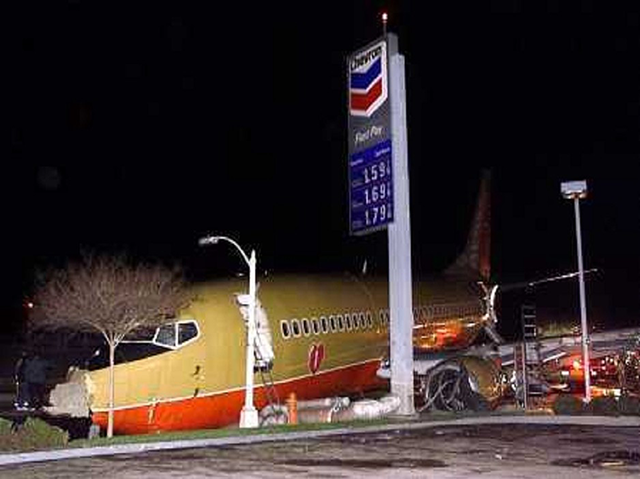
On March 5, 2000, about 1811 Pacific standard time (PST), Southwest Airlines, Inc., flight 1455, a Boeing 737-300 (737), N668SW, overran the departure end of runway 8 after landing at Burbank-Glendale-Pasadena Airport (BUR), Burbank, California. The airplane touched down at approximately 182 knots, and about 20 seconds later, at approximately 32 knots, collided with a metal blast fence and an airport perimeter wall. The airplane came to rest on a city street near a gas station off of the airport property.
Source: Aircraft Accident Brief DCA00MA030
Air Traffic Control put the crew in an almost impossible situation. I say “almost” because each pilot had several opportunities to say, “I’m not doing that.” Had they done so, the case of Southwest Airlines 1455 wouldn’t have become a standard chapter in many aviation safety textbooks.
If you were to place yourself in the situation these pilots faced at the conventional stable approach gate, passing 500 feet above runway elevation, the need to go around would be obvious. But if you rewind the clock to the first ATC instruction that set all this up, you probably would think nothing of it. “We can do that,” we think in an effort to help speed things along. Had these pilots taken their stable approach rules more seriously, they would have avoided the mess about to happen. But they had more than one opportunity well before that. As is often the case, we can read the NTSB accident report to understand what happened. But we won’t understand why it happened unless we go deeper.
The crew.
The 52-year-old captain was a U.S. Air Force pilot from 1970 to 1975, back when the commitment for pilot training was only four years. From there he went on to fly Gulfstream and Convair turboprops and then the Boeing 737 with Wien Air Alaska. He flew for a time on the program known to many as “Janet” out of Las Vegas, said to be a shuttle service to and from Area 51. He was hired by Southwest Airlines in1988 and upgraded to captain five years later. He said he had a total of 11,000 hours, of which 9,870 hours were with Southwest, and 5,302 were as pilot-in-command. This implies he only flew 1,130 hours during his previous 18 years. [DCAOOMA030, Accident Brief and Interview Summaries]
The 43-year-old first officer was also an Air Force pilot, having spent 12 years on active duty flying the F-15, followed by time with the Air Force Reserves flying the F-16. He was hired by Southwest in 1996. He said he had just over 5,000 hours, of which 2,522 were with Southwest. [DCAOOMA030, Accident Brief and Interview Summaries]
The captain’s entire Air Force experience after pilot training was at Mather Air Force Base, near Sacramento, California. That implies that he either flew the B-52 bomber or the KC-135 tanker, both with the Strategic Air Command. The third choice at that base was the T-43 navigator trainer but I don’t think new pilots were eligible for that assignment. The first officer’s entire Air Force experience was in Air Force fighters. The F-16, of course, is single seat. Most F-15s back then were also single seat.
In my opinion, from what we know about their backgrounds, both pilots started their careers with Southwest with scant experience in robust Crew Resource Management (CRM) cultures.
The airport.
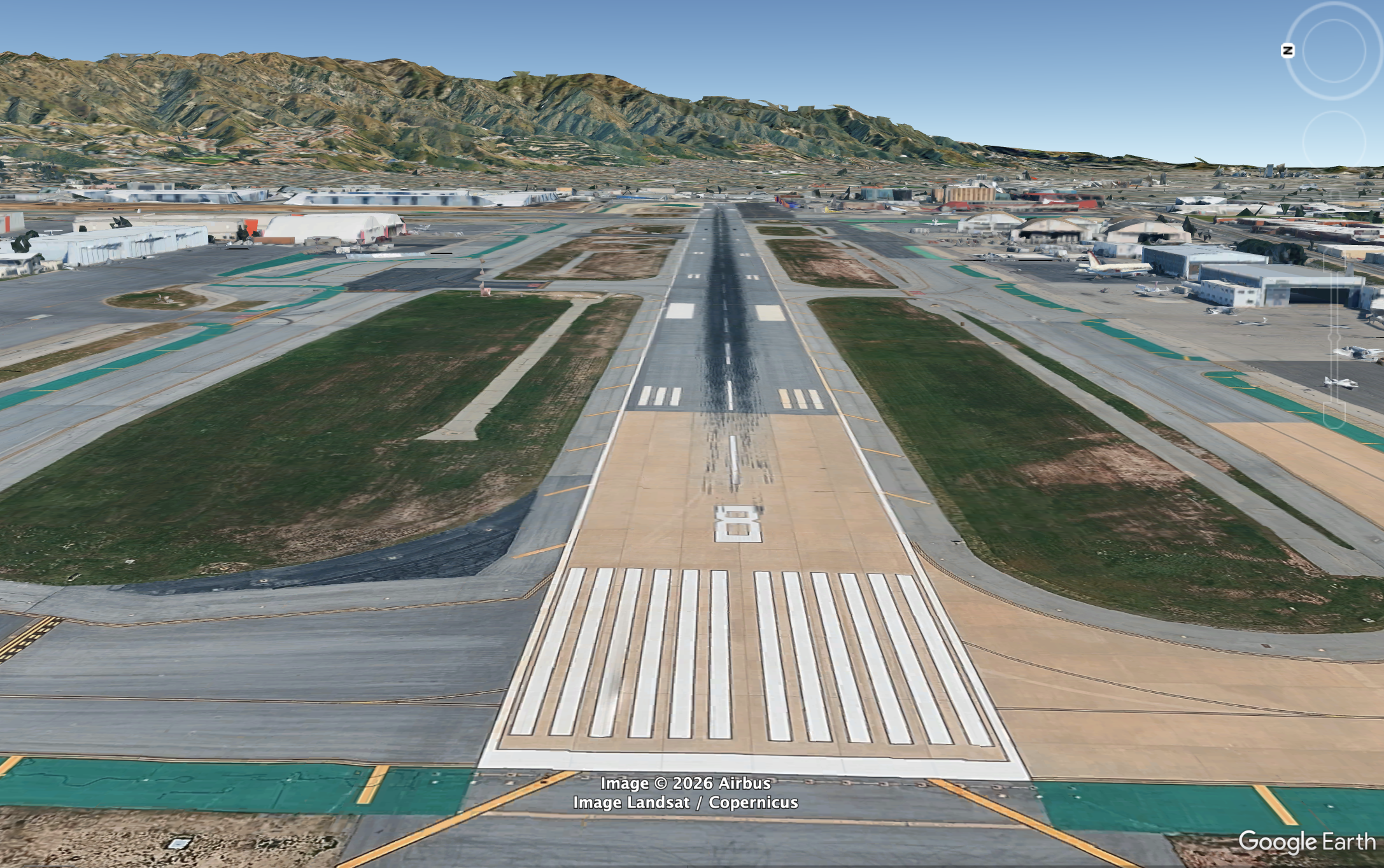
A view of Runway 8 and the surrounding mountains (GoogleEarth)
The Burbank Airport (KBUR) is about 3 miles northwest of Burbank, California, at an elevation of 775 feet, nestled at the end of the San Fernando Valley, between the San Gabriel Mountains and the Pacific coastline. The airport has two grooved asphalt runways, 8/26 and 15/33.
Runway 8 is 6,032 feet long and 150 feet wide, is configured for precision instrument landings. A precision approach path indicator (PAPI) is located 1,520 feet from the approach end of runway 8 on the left side of the runway. Runway 8 is the favored arrival runway because of the terrain on the opposite end. Runway 26 is only used when the tailwind on Runway 8 exceeds 10 knots and is from the northwest.
Runways 15/33 are longer than 8/26, but unfavored for arrivals. Runway 15 is the favored departure runway but rarely used for arrivals because of noise considerations over populated areas. Runway 33 is unfavored for arrivals because of terrain.
The configuration at the time of the accident was for the approaches to Runway 26 and 33, because the winds were fairly brisk, and Runway 15 for departures. The crew received early ATIS reports of winds at 260/18G26, but the last report they got from tower, just seconds before landing, was 210/6.
The accident flight.
The first officer stated that after the flight crossed the PMD very high frequency omni-directional radio range (VOR) navigation transmitter at 8,000 feet, he obtained information Oscar from the BUR airport terminal information service (ATIS), which indicated that winds were from 260° at 18 knots, gusting to 26 knots, and that aircraft were landing on runways 33 and 26.
Source: Aircraft Accident Brief DCA00MA030
17:50:28 HOT-2 [First Officer] I'm sure glad I'm just watching this leg.
Source: CVR
Imagine yourself in one of the pilots’ seats for this scenario. The airport was busy and there was a steady stream of airplanes ahead of you. Everyone was making it in without problems. See the accompanying ground track chart.
Note: the chart that follows is extracted from two diagrams in the NTSB report and the CVR. The elevation of the runway is given as 727’ MSL but I’ve used 700’ because the other altitudes are approximated as well. I’ve used this to compute an approximate Above Ground Level (AGL) but it is really the height above the runway elevation.
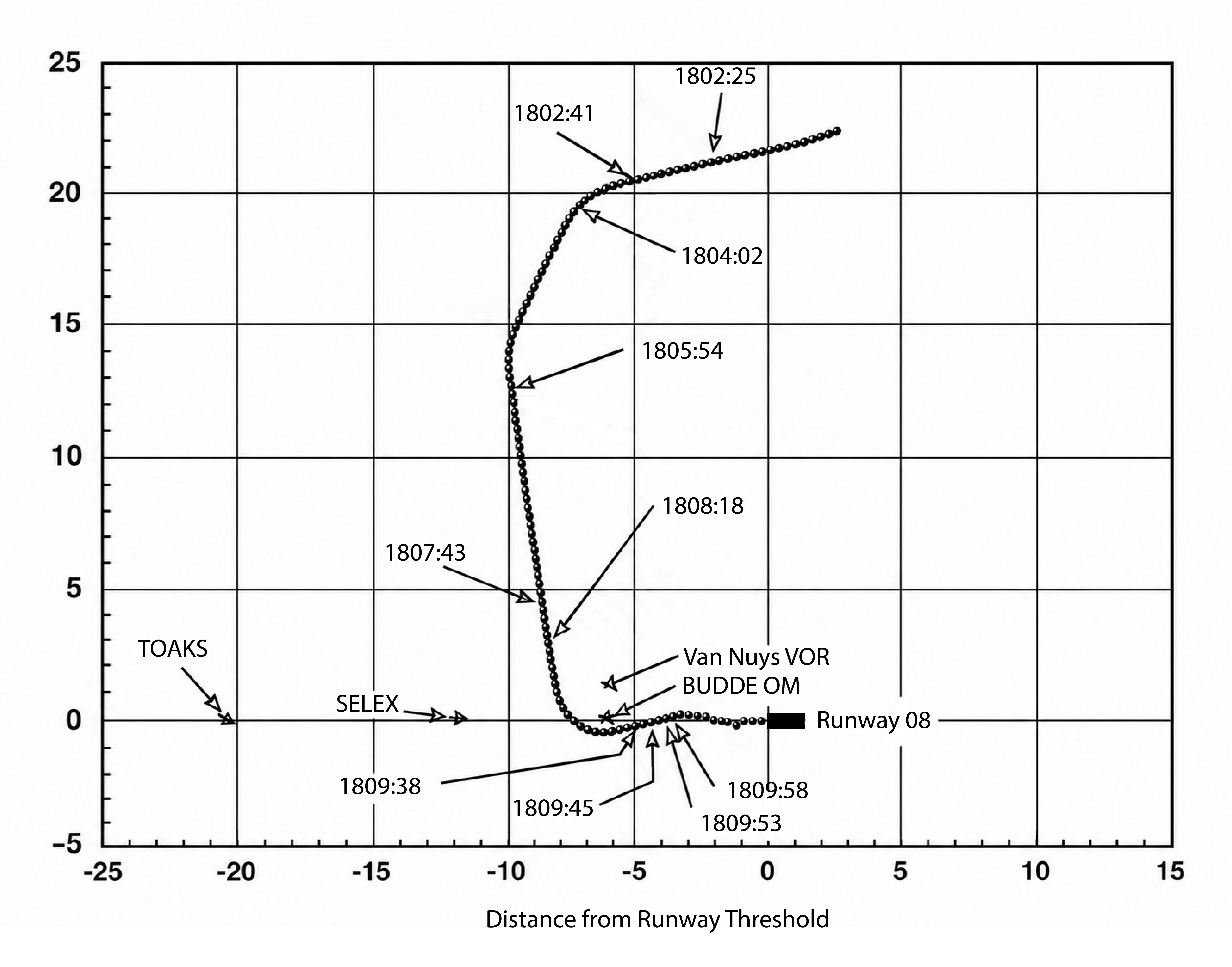
Ground track
1802:25 – [8,000’ MSL, 7,300’ AGL, 33 track miles to go] The crew was handed over to SOCAL approach where they checked in and were told ATIS PAPA was current and to expect an ILS to Runway 8. The crew said they would get PAPA and were then given a frequency change.
1802:41 – [8,000 ‘ MSL, 7,300’ AGL, 31 track miles to go, 235 ft/nm] The crew checked in on the new frequency and were given clearance to 6,000’ and instructions to turn left heading 190. The first officer handed off radio responsibilities to the captain, presumably to get the ATIS.
The ATIS was: "Burbank airport information papa, 0153 Zulu, wind 240 at 6, visibility 19, few clouds at 6,500, ceiling 9,000 overcast, temperature 9 dew point 1 altimeter 29.65, ILS runway 8 approach in use, arriving and departing runway 8 and runway 15."
1804:02 – [Descending through about 7,500’ MSL, 6,800’ AGL, 28 track miles to go, 243 ft/nm] The crew was instructed to “maintain two thirty or greater till advised please.” The first officer returned and took ATC responsibilities; the captain relayed the 230 or greater instruction.
1805:54 – [6,000’ MSL, 5,300’ AGL, 22 track miles to go, 241 ft/nm, 230 knots] The crew was instructed to descend and maintain 5,000 and “if you would like the visual approach you will be following company right now at your one o’clock and twelve miles turning onto final out of forty-six hundred.”
The captain said to the first officer “I want to get through these clouds but I think the visual will be fine.” They may or may not have realized that their company traffic was turning onto a longer final, since from their heading that aircraft was at their one o’clock position.
1807:43 – [5,000’ MSL / 4,300’ AGL, 13 track miles to go, 330 ft/nm, 230 knots] The crew was instructed: “descend and maintain three thousand, company’s over Van Nuys at three thousand.” The first officer acknowledged the clearance and added “lookin’ for company over Van Nuys.”
The pilots agreed that a visual approach was desirable but knew they had to spot company traffic first to make that happen. At this point they were only slightly above the optimal 3° (318 feet per nm) descent and about 30 knots faster than what many pilots shoot for at this distance from the runway.)
1808:18 – [Descending through 4,500’ MSL / 3,800’ AGL, 11 track miles to go, 345 ft/nm, 230 knots] The crew reported, “company in sight.”
1808:19 – [Descending through 4,400’ MSL / 3,700’ AGL, 10 track miles to go, 370 ft/nm, 230 knots] The crew was instructed, “Cross Van Nuys at or above three thousand, cleared visual approach runway eight.” The crew acknowledged.
Once cleared the approach, the previous speed restriction is deleted, as noted in the Airman’s Information Manual: “Approach clearances supersede any prior speed adjustment assignments, and pilots are expected to make their own speed adjustments as necessary to complete the approach. … previously issued speed adjustments will be restated if that speed is to be maintained….”
There is a fair amount of speculation “out there” that the crew didn’t realize their speed restriction had been removed. I disagree, because after the clearance was issued the aircraft decelerated to 220 knots, presumably to meet the 230 VFE for flaps five, and the captain asked for and the first officer selected flaps five. The NTSB notes that they could have asked for the speed restriction to be removed sooner, but they didn’t.
1809:29 – [3,000’ MSL / 2,300’ AGL, 5.5 track miles to go, 418 ft/nm, 220 knots] The aircraft reached 3,000 ft. At this point they were beyond Van Nuys and the 3,000 ft restriction no longer existed, but they were faced with also needing to slow down.
1809:38 – [3,000’ MSL / 2,300’ AGL, 5 track miles to go, 460 ft/nm, knots] The crew was handed off to Burbank Tower. Their configuration was flaps 5 and the gear was up.
1809:48 – [3,000’ MSL / 2,300’ AGL, 4 track miles to go, 575 ft/nm] The landing gear was selected down and the autopilot was disconnected.
1809:53 – [2,900‘ MSL / 2,200’ AGL, 3 track miles to go, 733 ft/nm] The crew checked in with Burbank tower and were cleared to land.
1809:58 – [2,800’ MSL / 2,100’ AGL, 2.9 track miles to go, 724 ft/nm] The crew began their descent to the runway, it appeared to be about a constant rate from this point on.
The math of their situation shows they needed a 6.8° descent angle and that is pretty close to what they did. From what I’ve heard, a Boeing 737 can make that descent, provided they start that descent on speed. What makes it impossible is the fact they were carrying an extra 50 knots.
1810:24 – The first of a series of GPWS “sink rate” and “whoop whoop, pull up” alerts were sounded. Between these, the pilots continued the checklist. At one point, the first officer said, “need any help?”
The captain told Safety Board investigators that he remembered hearing the “sink rate” warning from the GPWS but that he did not react to the warning because he did not feel that he had to take action. He stated that he did not remember any other GPWS warnings during the approach. The first officer indicated in a postaccident interview that he heard both the “sink rate” and the “pull up” GPWS warnings but that he believed that the captain was correcting. [Aircraft Accident Brief DCA00MA030]
At 1811:20, the cockpit area microphone (CAM) recorded impact sounds. The airplane departed the right side of the runway about 30° from the runway heading, penetrated a metal blast fence and an airport perimeter wall, and came to a stop on a city street off of the airport property. An emergency evacuation ensued, and all crewmembers and passengers successfully exited the airplane. [Aircraft Accident Brief DCA00MA030]
1811:46 – The captain says, “Well, there goes my career.”
Southwest terminated both pilots after the accident. The first officer was subsequently reinstated through the grievance process; the captain’s termination was also overturned, but he was permitted to retire.
The NTSB was quite critical of the air traffic controller, saying his actions “positioned the airplane too fast, too high, and too close to the runway threshold to leave any safe options other than a go-around maneuver.” [Aircraft Accident Brief DCA00MA030]
Understanding the Southwest “we can do that” culture.
The crew had to have known they were being pushed into a corner, but all those airplanes in front of them seemed to deal with it, no problem. And some of those were not even Southwest Airlines! If lesser airlines could handle this, surely it would be no problem for them! But they didn’t know their vector was well inside normal and they had far less room to lose speed than any of the aircraft before them. Still, the idea of going around never seemed to cross their minds. Why?
We pilots understand that being expeditious in the air will get us on the ground sooner and when we do this, we also speed things up for other aircraft. We feel a kinship with our air traffic control partners and if we can help them, we will. But we professional pilots also understand that there comes a time when “we can do that” needs to change to “unable.” That is a word I’ve used many times over the years and only twice did that result in a directed “go around” call from ATC. I was fully prepared to divert both times but got good service for the second approaches. Easy. But, as we know, some pilots are more accommodating than others.
I once got a tour of a busy airport tower – back in the days when towers welcomed no-notice visits from pilots – and noted that all aircraft were approaching from a runway equipped with an ILS, but some were asked after they checked in to circle to another runway. It seemed the aircraft were typically right at 500 feet, but that is just a guess on my part. After a while I realized the only aircraft getting the circle were Southwest flights. I asked why and was told, “because they’re the only ones who agree to do it.”
Several of my Air Force squadron mates ended up flying for Southwest Airlines and I asked a few about this “can do” mentality. They told me the pilot culture at Southwest encourages the idea that Southwest pilots are a cut above all others and if it can be done, they can do it. Is this true? I don’t know but it might explain what happened to Southwest Airlines Flight 1455. Chris Manno and I investigate this idea in our book, “Whiskey Air,” available at Amazon and other fine book sellers.
"There I was . . .""
The only time I got into a debate on the radio over an “unable” call was about 30 years ago when we rarely talked about stable approach rules. We were cleared for a visual approach and I set up for a two-mile final, knowing that would get me wings level on runway extended centerline no later than 500 feet. Here is what happened next:
ATC to us: “Aim for the numbers, please.”
Me to the PM: “I’m not doing that.”
PM to ATC: “Unable.”
ATC to us: “Why not?”
PM to ATC: “Our SOP requires us to be wings level at 500 feet.”
ATC to us: “After you land I need you to give me a call, ground control will give you my number.”
PM to ATC: “Wilco.”
ATC to us: “Cleared to land.”
After we landed, we didn’t get a phone number and asked. Ground control told us to disregard the request. These days, I think most air traffic controllers are well schooled in the need for stable approaches and the “unable” call isn’t needed as often. And when we pilots say “unable” in that situation, I think most controllers understand immediately.
3
Tell the other pilot, "I'm not doing that."
Learjet 45XR, N279AJ, January 3, 2009, Telluride Regional Airport, CO
Before we dive into this case study, two questions: What is your aircraft’s approach category? Does approach category apply to straight-ins as well as circling approaches?
Is there room for debate? When I first flew the Challenger 604, the manuals clearly stated the aircraft was Category D, end of discussion. A year after I was typed, that statement was removed. Being a Cat D aircraft doesn’t sell airplanes that are used for getting in and out of small airports. The numbers clearly demonstrated the aircraft was Cat D, but pilots started assuming the aircraft was Cat C. I’ve had the debate at the simulator. Cat C airplanes sell.
According to 14 CFR 97.3, “Aircraft approach category means a grouping of aircraft based on a speed of VREF, if specified, or if VREF is not specified, 1.3 VSO at the maximum certificated weight.” My Challenger instructors argued that the maximum landing certificated weight didn’t apply to their aircraft, since VREF was not specified. In 2012, the FAA issued a memorandum saying the maximum certificated weight does apply to aircraft using the 1.30 VSO provision. More about this: Approach Categories.
What about that second question? Do approach categories apply to straight-in and circling approaches, or just circling approaches? The answer is in AIM 5-4-7, which lists the applicable categories and speeds and then says: “VREF in the above definition refers to the speed used in establishing the approved landing distance under the airworthiness regulations constituting the type certification basis of the airplane, regardless of whether that speed for a particular airplane is 1.3 VSO, 1.23 VSR, or some higher speed required for airplane controllability. This speed, at the maximum certificated landing weight, determines the lowest applicable approach category for all approaches regardless of actual landing weight.”
The phrase “all approaches” should end the debate. So those two questions answered, on to the case of “tell the other pilot I’m not doing that.”
“I mean we could almost circle and do it. Wanna try?”
For many of us, circling is one step away from an emergency procedure. Even if that isn’t true, “almost circling” ought to be. The correct answer is “no, I’m not doing that.” But that wasn’t the answer in this next case study.
An “off-runway landing”
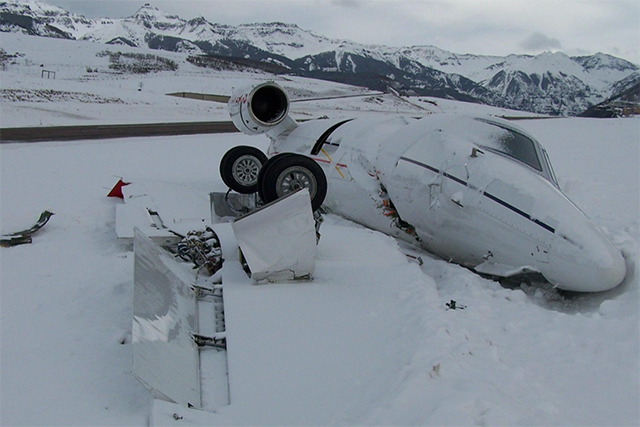
N279AJ Wreckage,
NTSB Accident Docket CEN09LA116
On January 3, 2009, at 1659 mountain standard time (MST) a Learjet 45XR, N279AJ, sustained substantial damage during an off-runway landing at Telluride Regional Airport (KTEX), Telluride, Colorado. The airplane was owned by LJ279, LLC, Missoula, Montana, and operated by Aero Jet Services, Scottsdale, Arizona. The airline transport pilot in the left seat was not injured and the airline transport pilot in the right sear received minor injuries. Intermittent visual meteorological conditions were present at the time of the accident and an instrument rules flight plan was filed for the Title 14 Code of Federal Regulations Part 91 positioning flight. The cross-country flight originated at the Scottsdale Airport (KSDL), Scottsdale, Arizona, at 1503.
Source: NTSB Aircraft Accident Narrative, CEN09LA116
The sequence of events leading to the crash make little sense to most professional pilots, since pilot actions seemed contrary to good airmanship. It will be helpful to look at both pilots before looking at what happened.
The Pilot in Command (PIC) was the Pilot Monitoring (PM) in the right seat. He had 4,800 hours total flying time of which 1,038 hours were in type. He held three type ratings: CE-525, LR-45, and LR-JET. He was 42 years old. The Second in Command (SIC) was the Pilot Flying (PF) in the left seat. She had 3,520 hours total flying time of which 831 hours were in type. She held two type ratings: LR-JET and LR-45. She was 36 years old.
There doesn’t seem to be a great deal of difference between pilots that cause the term “authority gradient” to pop out. The PIC/PM wasn’t much older or senior in terms of experience. But the SIC/PF’s actions indicated a deference greater than I would expect. The NTSB failed to dive deeper into this and there is no record of the PIC/PF also having a position of authority over the SIC/PM.
An Instrument Approach “for reference”
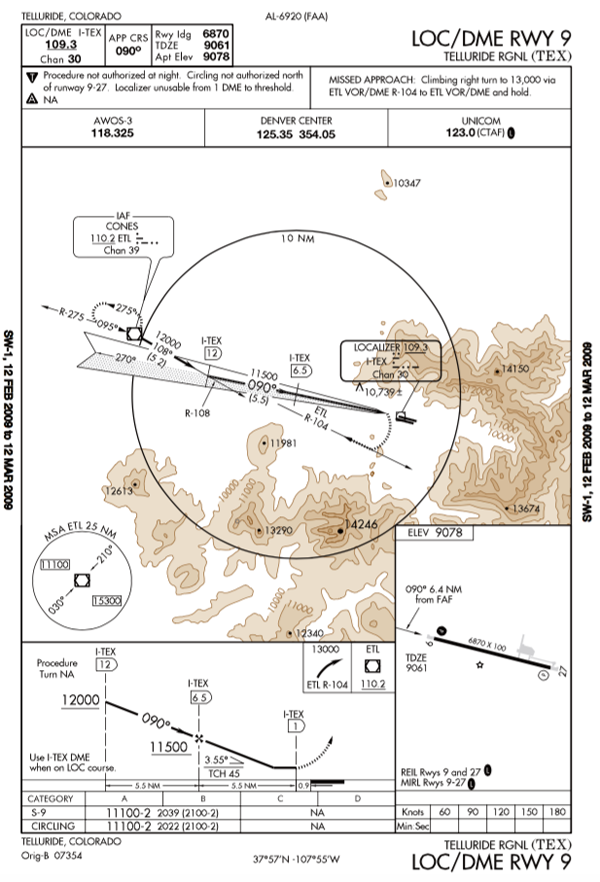
KTEX LOC/DME Rwy 9 approach plate, from NTSB Accident Docket CEN09LA116
At approximately 1640 local (2340 zulu), we requested descent in the hold and clearance to KTEX. Flight conditions were approximately 5 sm and haze. Using the LOC/DME Rwy 9 approach for reference, we departed ETL east towards KTEX. Upon switching frequencies from center to CTAF, I informed the Unicom and local traffic that we were inbound to the airport. Unicom replied and informed us that there was 1” of snow on the runway, and that they were not planning on plowing until the next day. We continued the approach. At approximately 4 sm from the airport, I acquired the runway environment visually and informed the copilot. She was having difficulty in identifying the runway, and after repeated attempts at locating it, I called for a missed approach.
Source: PIC/PM statement, Pilot/Operator Aircraft Accident/Incident Report, CEN09LA116
The fact the PIC/PM was careful to state they used the approach “for reference,” tells us he was aware their approach category made this approach unusable as an instrument procedure. If they really were flying under Visual Flight Rules I think the PIC/PM would have called for a go around and not a missed approach, but that is probably too fine a point at this point. (But there is more to come.)
The Learjet 45 AFM for N279AJ shows a VREF of 123 KIAS at sea level to 6,000 ft, 124 KIAS at above that. It is a Category C aircraft. It appears the PIC/PM knew that.
Authority Gradient: PIC/PM’s perspective
The fact the PIC/PM referred to the SIC/PF as the copilot, when he was in the copilot crew position, tells us that he didn’t really invest in her the authority of the pilot flying the airplane.
Runway Contamination
The PIC/PM’s recollection about “1” of snow on the runway” is interesting, indicating he downplayed the actual report:
“. . . about an inch and a half or so of snow on the runway, we have not plowed it we were waiting until tomorrow, we’re scattered at three hundred overcast at seventeen hundred and heavy snow.”
Source: CVR, CEN09LA116
I have a copy of the Learjet 45 AFM dated 2004, but do not know if that was current for the 2009 date of this accident. That AFM, Section V, says “A runway is considered to be contaminated when more than 25% of the runway surface (whether in isolated areas or not) within the required length and width being used, is covered by more than 1/8 inch (3 mm) of standing water or by slush or loose snow, equivalent to more than 1/8 inch (3 mm) of water.” The AFM gives correction factors for up to 1.5 inches of loose snow, but no actual limitation. I think the PIC/PM knew they were operating at the edge of the aircraft’s capabilities.
What the PF/SIC said happened during the “approach” and landing
“We had been cleared for approach again by ATC. Upon reaching our MDA we held altitude until we were sure we had the runway in sight. Approximately 4 miles out we both had the runway in sight. At that time our altitude for a normal descent was little high because we held MDA for a bit longer and seeing that we were and could remain in visual conditions, Mike suggested a 360° turn. In our turn I began a descent. At the completion of the turn, I rolled out on the PAPI and on the extended centerline of the runway so I continued my descent to land still remaining in visual conditions. During the descent to the round out phase both Mike and I had the PAPI in sight to the left and the right-side runway edge identifier lights to our right. During my round out my eyes made a transition to the end of the runway. Between the round out to touchdown Mike was telling me to get it down on the runway but at the same time I was correcting for an unexpected gust of wind from the left, as I was having to apply wind correction to remain center of the runway. As the mains touched down the landing was normal. The nose began to lower but continued until [I] saw it fall into the snow, then it felt as if we began to roll. When the aircraft came to a stop, we exited through the emergency exit with the assistance of the rescue team. It was not until the following night that Mike and I were informed that we had not landed on the runway.
Source: SIC/PF statement, Pilot/Operator Aircraft Accident/Incident Report, CEN09LA116
What the SIC/PF and PIC/PM actually said
The CVR labels the PIC/PM as HOT-1 and the SIC/PF as HOT-2, which I think is opposite convention but might be an indication that the NTSB knew who was really “running the show.”
On the second attempt they were at the MDA and had this exchange:
16:56:40 EGPWS minimums. minimums.
16:56:49 HOT-1 we ain't gonna make it. three miles from the runway and we're still two thousand feet above the runway.
16:56:56 HOT-2 #.
16:57:04 HOT-2 and the runway is the missed?
16:57:06 HOT-1 no one mile from and we're two uh one mile from that.
16:57:17 HOT-2 #.
16:57:20 HOT-1 oh #. naw there's the runway way down there. we'd have to circle down and go...
16:57:21 HOT-2 yea we're not gonna make that. #.
Source: CVR, CEN09LA116
The MDA was 2,039' above the runway; they would have needed to spot the runway at 6.4 nm to have a normal 3° glide path. The FAF was 500' higher than the MDA but only 6.5 nm from the end of the runway. A stable instrument approach was impossible from the FAF at the published FAF altitude. As is typical with many approaches in mountainous areas, you need to spot the runway well before the final approach fix. This should be part of the approach briefing; you don't want to find yourself at minimums approaching the missed approach point and having to figure this out.
16:57:23 HOT-1 I mean we could almost circle and do it. wanna try?
16:57:27 HOT-2 I don't. [sound similar to sigh].
16:57:27 HOT-1 circle this way.
16:57:28 HOT-2 uuhhh...
16:57:29 HOT-1 try it.
Source: CVR, CEN09LA116
Even if their aircraft’s category allowed for a circling approach, which wasn’t the case, they did not brief a circling approach. The SIC/PF’s “I don’t” would have been better phrased, “I’m not doing that” to end the debate. But she begrudgingly went along.
16:57:31 HOT-2 [sound similar to manual disconnect of autopilot]
16:57:31 HOT-1 go this way. cut it in tight though. if you go back in the clouds we're going missed. cut it tight.
Source: CVR, CEN09LA116
The flight data recorder indicates the bank angle reached 45° at several points.
16:57:45 HOT-2 I need to maintain that altitude.
16:57:47 HOT-1 ah don't no...you're gonna have to please.
16:57:50 HOT-2 what?
16:57:50 HOT-1 i think i think we're about to go back into the clouds.
16:57:52 HOT-2 oops.
Source: CVR, CEN09LA116
As they rolled out the PIC/PM spotted the runway . . .
16:58:14 HOT-1 keep bringing it down keep it slow, slow, there's the runway right there.
16:58:19 HOT-2 ooh.
16:58:22 HOT-1 keep it slow. take the power out. see the lead in light ah the blinker.
16:58:30 HOT-2 no i don't see anything yet.
16:58:33 HOT-1 there's the runway.
16:58:34 HOT-2 oh # ... are you kidding me?
16:58:35 HOT-1 yea... you need you need to be down.
16:58:41 HOT-1 get ready for full thrust reverser.. middle's over here.
16:58:43 HOT-2 **
16:58:48 HOT-1 just put it down. put it down.
16:58:51 HOT-2 I'm trying. where is it?
Source: CVR, CEN09LA116
In her post accident statement, the PF said she spotted the runway prior to landing. It is evident here she did not see the runway while below the MDA.
16:58:53 HOT-1 put it down. it's right here.
16:58:54 EGPWS sink rate.
16:58:55 HOT-1 put it down.
16:58:56 EGPWS sink rate.
16:58:56 HOT-1 put it down.
16:58:57 HOT-2 i...
16:58:57 EGPWS fifty.
16:58:58 HOT-1 I know you don't want to listen to me.
16:58:58 EGPWS forty.
16:58:59 EGPWS sink rate.
16:59:00 HOT-1 put it down.
16:59:00 EGPWS twenty.
16:59:01 HOT-1 don't float it.
16:59:01 EGPWS sink rate.
16:59:02 HOT-1 put it down.
16:59:02 HOT-2 #.
16:59:03 EGPWS ten.
16:59:05 HOT-1 full thrust reverser.
16:59:06 CAM [sound similar to initial impact]
16:59:07 CAM overspeed [aircraft aural warning]
16:59:09 HOT-2 oh god...no no.
Source: CVR, CEN09LA116
An on-scene investigation was conducted by a Federal Aviation Administration (FAA) inspector. The initial examination of the area indicated that the airplane had touched down about 20-feet to the right, and off, the runway. Additionally, the airplane's wings were torn from the fuselage. The tail section had separated just aft of the engines. No pre-impact anomalies with the airframe and engines were detected during the investigation.
Source: CVR, CEN09LA116
Authority Gradient: SIC/PF’s perspective
The NTSB did not appear to investigate the steep authority gradient evidence by the PIC/PM to the SIC/PF. The SIC/PF started to assert herself with her “I don’t” statement but she gave up on that when the PIC/PM followed immediately with “circle this way.” I think his statement just prior to the crash exhibits a type of aggression typical with this sort of relationship: “I know you don't want to listen to me.”
Probable Cause
The National Transportation Safety Board determines the probable cause(s) of this accident as follows: The failure of both pilots to positively identify the runway prior to landing.
Source: Statement of Probable Cause, CEN09LA116
Actual Cause
I think the NTSB failed to give this accident enough attention to get it right. Yes, both pilots failed to positively identify the runway. But why did this happen?
I took my first course in Crew Resource Management (CRM) in 1986 and within a year I was an advocate. It spoke to the safety officer in me, as well as the fallible pilot I knew I was. The more help, the better! By 2009, when this accident took place, every aircraft initial and recurrent course I ever attended included at least a brief discussion about CRM. I’ve been a standards pilot, evaluator pilot, or check airman off and on (mostly on) since before that first CRM course. Even before I heard the term, the crew’s ability to communicate was one of my frequent critique items. No doubt about it, by 2009, CRM was a mainstream idea.
We can make the same statements about situational awareness, stable approaches, threat error management, and so forth. Just adjust the dates a little but you get the idea. All these buzz words are just that, buzz words, unless you are paying attention. Then they become tools for your arsenal to make flying easier and safer.
I suspect that with both pilots in this case study, all those courses were just “eye wash” for the course, agenda items to make the course syllabus look good, the instructors look smart, and the students appear well trained. But none of this does any good unless everyone involved takes the lessons themselves seriously. The PIC/PM may have answered all the questions correctly in the CRM test, but he failed out in the field when ignorning the SIC/PF’s reservations about circling. The SIC/PF might be able to spout out the idea that she has to be on course, on glide path, on speed, fully configured at 500 feet, but that hardly matters when she wraps the aircraft into 45° of bank on a base turn that probably rolled out just one or two hundred feet off the deck.
Let’s say you were in her position, as the pilot flying in the left seat with somebody senior to you in the right seat. Let’s say that person is your boss who signs your paycheck and can get you fired for the least offense. Now that person wants you to do something you know is wrong. Saying, “I’m not doing that” can have several results. It could be your last flight with that operation. It could be that saying no is just what the senior person needs to shake off the target fixation – what the CRM gurus call continuation bias – and will win you newfound respect. Or it could be something between those two extremes. I would argue any of those results are better than finding out the next day you didn’t actually land on the runway.
“There I was . . .”
One of the advantages of being thrown into a large pool of pilots, as happens in the Air Force, the Navy, and many large airlines, is that you get exposed to a broad cross section of peers. You learn that some are good, some are bad, and most sit someplace between. You learn that just because someone senior to you says a course of action is the only option, that is probably not true. If you’ve spent your career in small pilot pools, you might not realize that the boss might be the worst pilot of the bunch. For me, the most poignant lesson came when I was a 23-year-old lieutenant, flying in the right seat of a KC-135A, saying “yes sir” to an aircraft commander who out ranked me (he was a captain), who was older than me (he had just turned 30), and was my boss (he signed my performance reports.) There we were, returning from air refueling B-52s somewhere over the Atlantic, and we were faced with a thunderstorm between us and our base. The navigator spotted the buildup on his monochromatic radar: “it’s a big one.” I looked out the window and spotted it. It went higher than we could climb, but I thought we could fly around it with no more than an additional 15 minutes of flying time.
“Recommend left or right, 30 degrees,” the navigator said.
“Let’s go right,” I said, “upwind, more better.”
“Nah, I don’t want to have to explain the extra flight time,” the aircraft commander said. “It’ll be fine.”
Captain Don Leishman was a pleasant enough fellow, but he had been in trouble a few times with the squadron for what I heard were all bad judgement calls. Since I was assigned to his crew, he seemed hyper interested in flying everything exactly as published. No deviations allowed.
“You aren’t going to fly through a thunderstorm, are you?” I asked.
“Just watch me,” he said.
“I’m not doing that,” I said. “Not only that, I’m not going to let you do that.”
“Listen, lieutenant,” he spat out, and then fell silent. Our radar repeater up front was a smaller version of the nav’s. It was monochromatic as well, just showing green stuff where it was bad, nothing where it was good. The green blob in front of us grew larger and we approached. Don sat and thought. “Okay,” he finally said. “We’ll fly underneath it.”
“I’m not doing that either,” I said. “The vertical gusts from that thing will make mincemeat out of us.”
Don sat and thought some more. “If I get hauled in to see the squadron commander, you’re coming with me.”
“My pleasure to do just that.”
Of course, that never happened. In fact, another tanker behind us took some damage flying through the same build up. “Can you believe that!” Don said to one of his fellow aircraft commanders. “What an idiot, trying to fly through a thunderstorm!”
4
Tell Yourself: “I’m not doing that”
Through these examples we see that there is pressure from the boss, from air traffic control, and even from our fellow pilots to do something we might not want to do. In most cases, the initial requests are innocuous in themselves. Extend the duty day just a little? No problem. Hold a higher speed for just a little longer to help out the aircraft behind you? Of course! Assume the checklist is done to help speed things along? Why not!
Even if the first requests are perfectly harmless and something you’ve done a hundred times before, there comes a time when request after request piles up and you realize that you are venturing into unchartered territory. If your inner monologue says, “I’m not doing that,” it is probably time to give those silent thoughts some volume.
I recommend you take the next request from the boss that stretches your personal safety boundaries and go on record. Some things are nonnegotiable for safety because the environment is fluid and even the best pilots can be bested by aircraft problems, conflicts with other aircraft, or frailty of the system itself. I’ve heard a few variations of this: “Why can’t you do this? Joe does it all the time.” My answer: “Joe has a higher risk tolerance than me. It could be he has more relevant experience or it could be just the opposite. My experience tells me this incurs an unacceptable risk.”
You should realize that in a war of wills between you and air traffic controller, you will never lose so long as you are complying with regulations and favor the more conservative approach. You might have to go around, and you might have to make a phone call. But as long as you can say your actions were safer than the alternative, you cannot be faulted.
Finally, when dealing with your fellow pilots, as soon as they realize you are one of those aviators who always tries to follow the rules, they will stop asking you to bend those rules. As with that case where we were asked to aim for the numbers, making a stable approach impossible. My cross-cockpit oath, “I’m not doing that,” didn’t need a translation. The other pilot knew instantly and issued our “unable” with an air of finality.
The irony in all this is that I suspect those who push us into these corners gain respect for us when we say, “I’m not doing that.” What seems traumatic to us at first, might actually be the best thing we can do. Or it may be a nonevent. Either way, it is a better outcome.
References
(Source material)
Cessna 680A, N8JR
NTSB Aircraft Accident Docket, CEN09LA116
NTSB Aircraft Accident Narrative, CEN09LA116
Southwest Airlines 1455
NTSB Aircraft Accident Brief, DCAOOMA030, Southwest Airlines Flight 1455, Boeing 737-300, N668SW, Burbank, California, March 5, 2000
NTSB Specialists Factual Report of Investigation, DCA00MA030, Cockpit Voice Recorder, April 20, 2000
NTSB Operational Factors Group Chairman's Factual Report, Interview Summaries, DCAOOMA030
Learjet 45XR, N279AJ
NTSB Aircraft Accident Docket, CEN09LA116
NTSB Aircraft Accident Narrative, CEN09LA116
NTSB Group Chairman’s Factual Report of Investigation, Cockpit Voice Recorder, ERA19FA248, NTSB Record of Conversation, ERA19FA248, Aug 16, 2019